Click on the following link for an archive of a webinar Cassandra O'Neill did with Amy Schaller called New Engagement Strategies for 21st Century Evaluation on March 21, 2011.
http://www1.cyfernet.org/onlinepd/03-11-NewEngage.html
http://www.wholonomyconsulting.com
Tuesday, April 19, 2011
Webinar Archive New Engagement Strategies for 21st Century Evaluation


Wednesday, March 9, 2011
NCRP blog post on Better Evaluation Practices for Philanthropy
posted on: Friday, March 04, 2011
By Meredith Brodbeck
When it comes to philanthropic giving, people want to see results. They want to know that their contributions are making a difference and helping to “move the needle” on larger issues.
Does the current practice of evaluating philanthropy show that our gifts are delivering? Is quality of life improving? And how can the practice of evaluation evolve to better answer such questions?
Steve Mayer, of the Effective Communities Project, takes on these issues in his Responsive Philanthropy article “Wanted: Better Evaluation Practices for Philanthropy”.
He points out that giving is often too individual and therefore can easily overlook the greater systemic issues.
“Funding the rescue of one person at a time evokes evaluation practices that score success one person at a time, however temporary. Evaluation, asked to give an accounting of these rescue efforts, gives adequate information on how many people receive soup, or affordable housing, or their day in court. These data may answer the question well enough, but they say nothing about the bigger question, “Are we stemming the flow of hungry, homeless or wronged people?” Both charitable and structural reform efforts are needed to stem these flows, with evaluation practices that honor the difference.”
Mayer suggests nine different ways to make the practice of evaluation - and philanthropy - better. Among them are:
1. Recognize that a better world is not built in one day. “If we accept this, we can escape the limitations of short-term management thinking.”
2. For any problem, adopt a set of metrics that reflect current progress. “It’s important for anchoring a serious effort, for engaging community support and for keeping eyes on a jointly held prize.”
3. “Identify what moves these needles, and what keeps them from moving, to make clear what kinds of efforts to support.”
4. “Look beyond the capabilities and performance of one organization, and look instead to supporting a more organized and intentional effort.”
To see the rest of Mayer’s suggestions and learn additional ways to improve the evaluation of philanthropy, read the full text of “Wanted: Better Evaluation Practices for Philanthropy”.
Meredith Brodbeck is communications associate at the National Committee for Responsive Philanthropy (NCRP).
Labels: effective philanthropy, evaluation, evaluation resources, Measuring Impact, Responsive Philanthropy
http://blog.ncrp.org/2011/03/how-can-practice-of-evaluating.html
http://www.wholonomyconsulting.com
Wednesday, February 9, 2011
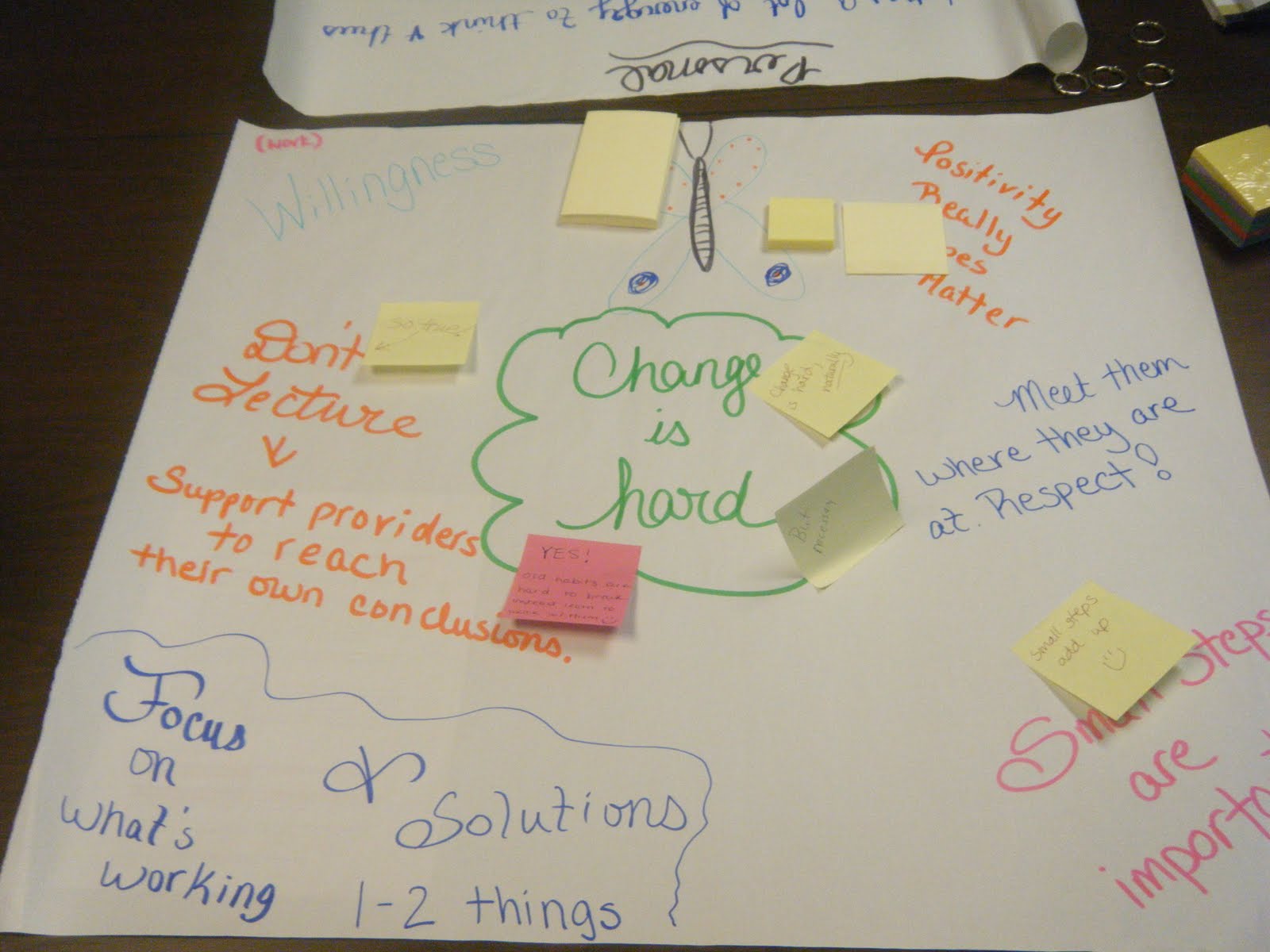
Photos from Feb 8 training - implications of brain research on resiliency


http://www.wholonomyconsulting.com


Tucson Coach Trainings Spring 2011
Fundamentals of Effective Coaching Workshop
Participants will learn communication tools and skills they can use to work effectively with others in a way that promotes self-direction. Listening, paraphrasing, and asking powerful questions are fundamental coaching skills which can be applied to communication with individuals and groups. These coaching skills are based on what research shows supports thinking, learning and growth.
Option 1 -- Saturdays March 5, 19 from 12:30 p.m. - 3:30 p.m.
Option 2 -- Tuesday April 5, Monday April 11 from 6:00 p.m. – 9:00 p.m.
Option 3 -- Saturday May 7 from 9:00 am – 3:00 p.m.
Two Day Advanced Coaching Workshop -- June 2-3, 2011
The Advanced Coaching workshop is open to anyone who has had the Fundamental Coaching Workshop. Topics covered as part of the Fundamental Coaching workshops include: information on how the brain works as it relates to effective coaching, key elements to developing trust and rapport with others, listening set-asides for coaches, and the following coaching response behaviors: pausing, paraphrasing, and asking invitational questions.
Contact Sarah Griffiths at (520) 271-7970 or slmgriffiths@hotmail.com for registration information
http://www.wholonomyconsulting.com
Learning Opportunities -- High Impact Facilitation and Presenting Training
Workshops offered through Professional Development Alliance
Tucson, Arizona
Spring 2011
Facilitating Meeting Using Whole Systems Methods -- June 9, 2011
Topics include the common principles of Whole System Methods, how Whole System Methods align with recent research on how the brain works and strengths-based approaches to change, the benefits of using Whole System Methods, crafting invitational and appreciative questions, and instruction in how to use the following Whole System Methods: Appreciative Inquiry, The World Café and Open Space Technology.
Making Meetings Matter—A workshop on Designing and Facilitating Effective Meetings, Coalitions, and Change Processes -- May 5, 2011
Recent research on how the brain works, how people learn and grow, and the power of internal motivation call for new ways of structuring meetings and change processes. This workshop will teach participants the following: New scientific research that affects the design of meetings and change processes, Highlights of material in Switch: How to Make Change When Change is Hard by Chip and Dan Heath, and Time to Think by Nancy Kline, and the 10 essential ingredients for creating a thinking environment for any meeting.
6 Secrets to Effective and High Impact Presentations -- April 14, 2011
Topics include: Recent neuroscience and brain research that contain the secrets to effective presenting and learning and exploring 6 “Secrets” that you can immediately put to use in your presentation and facilitation. We also provide ample opportunities to reflect on the implications and applications of this knowledge for our work in the social sector, individually and collectively. These secrets will increase the learning, retention, and engagement of any presentation exponentially. They are simple and easy to adopt. Are you ready to increase your impact?
Contact Sarah Griffiths at (520) 271-7970 or slmgriffiths@hotmail.com for registration information
http://www.wholonomyconsulting.com
Wednesday, February 2, 2011
Chronicle of Philanthropy Artticle on CFSA System Change Work
January 9, 2011
A Grant Maker Requires Grantees to Collaborate
“No one agency can meet any one person’s needs,” says Sarah Jones, head of a social-service charity.
Nicole Wallace
The Community Foundation for Southern Arizona has made a big change in its grant making in response to the recession. The fund now awards grants only to coalitions of groups that work together to solve important community problems, not individual organizations.
The foundation last year brought 200 local nonprofit groups together to discuss what significant community change would look like and how they could work together to achieve it. Out of that process, the fund received 29 collaborative grant proposals. In September four partnerships received three-year grants of $225,000 each. They focus on women’s and girls’ issues, neighborhood revitalization in South Tucson, services for the elderly, and the dearth of healthy food in Ajo, Ariz.
The bad economy means that grant makers need to do more than just try to make up some of the money that government has had to cut, says Evan Mendelson, a vice president at the Tucson community fund.
“We actually need to change some of the paradigms of service provision,” she says. “And sometimes a crisis is the best time to do that.”
Closing Gaps
One of the problems organizations that provide services to the elderly identified was a lack of nursing homes and assisted-living facilities to accommodate baby boomers as more and more of them reach old age, says Ms. Mendelson.
Alone, no single group could take on the challenge, she says, but now that the groups are talking to each other and working together, they are devising a plan to create neighborhood-based services to help older people stay in their homes longer.
Evan Mendelson says “sometimes a crisis is the best time” to re-evaluate how services are provided.
Two more immediate benefits are that the collaborating groups can make sure they aren’t duplicating programs and can work to close gaps in the services they offer, says Ms. Mendelson.
“You can’t even see the gaps when you’re working in your own silos,” she says.
Better Quality Services
Emerge Center Against Domestic Violence, the Sahuaro Girl Scout Council, and the YWCA Tucson started working together as the Partnership for Women and Girls two years ago, even before the community foundation turned its attention to partnerships.
Traditionally when nonprofit groups think about collaboration, they think about organizations that share very similar missions working together, but that can be limiting, says Sarah Jones, Emerge’s chief executive. The Partnership for Women and Girls takes organizations that are related but not exactly the same to create a continuum of services.
The collaboration allows each group to focus on its area of expertise.
Emerge could follow the lead of a lot of domestic-violence shelters and hire an employment specialist to support its clients who need help to enter the job market.
But the organization could never provide the level of services that the YWCA does in its employment training, since that is a big focus of its operations, says Ms. Jones.
“No one agency can meet any one person’s needs¬—and probably shouldn’t,” she says. “When you try to start being everything to everybody, oftentimes you water down the quality of what you’re providing.”
http://www.wholonomyconsulting.com
Subscribe to:
Posts (Atom)